Algebra AI Solver
Master linear systems, quadratic functions, and polynomial factorization with our deterministic symbolic engine. Engineered for academic integrity and precision.
The Science of Symbolic AI in Modern Algebra
Algebraic computation has moved beyond simple arithmetic. In a digital-first academic world, students often encounter a significant problem with standard Large Language Models (LLMs): the lack of computational grounding. While a standard AI might "predict" that the root of a quadratic equation is a certain number based on similar text it has seen, our Algebra AI Solver utilizes Symbolic Regression and Heuristic Parsing.
This means the engine identifies the mathematical structure first. If you input $3x^2 + 5x - 2 = 0$, the AI doesn't look for a similar sentence; it identifies the coefficients $a, b,$ and $c$, calculates the discriminant $\Delta = b^2 - 4ac$, and follows the formal path of derivation. This deterministic approach guarantees that the "hallucinations" common in other AI tools are mathematically impossible here.
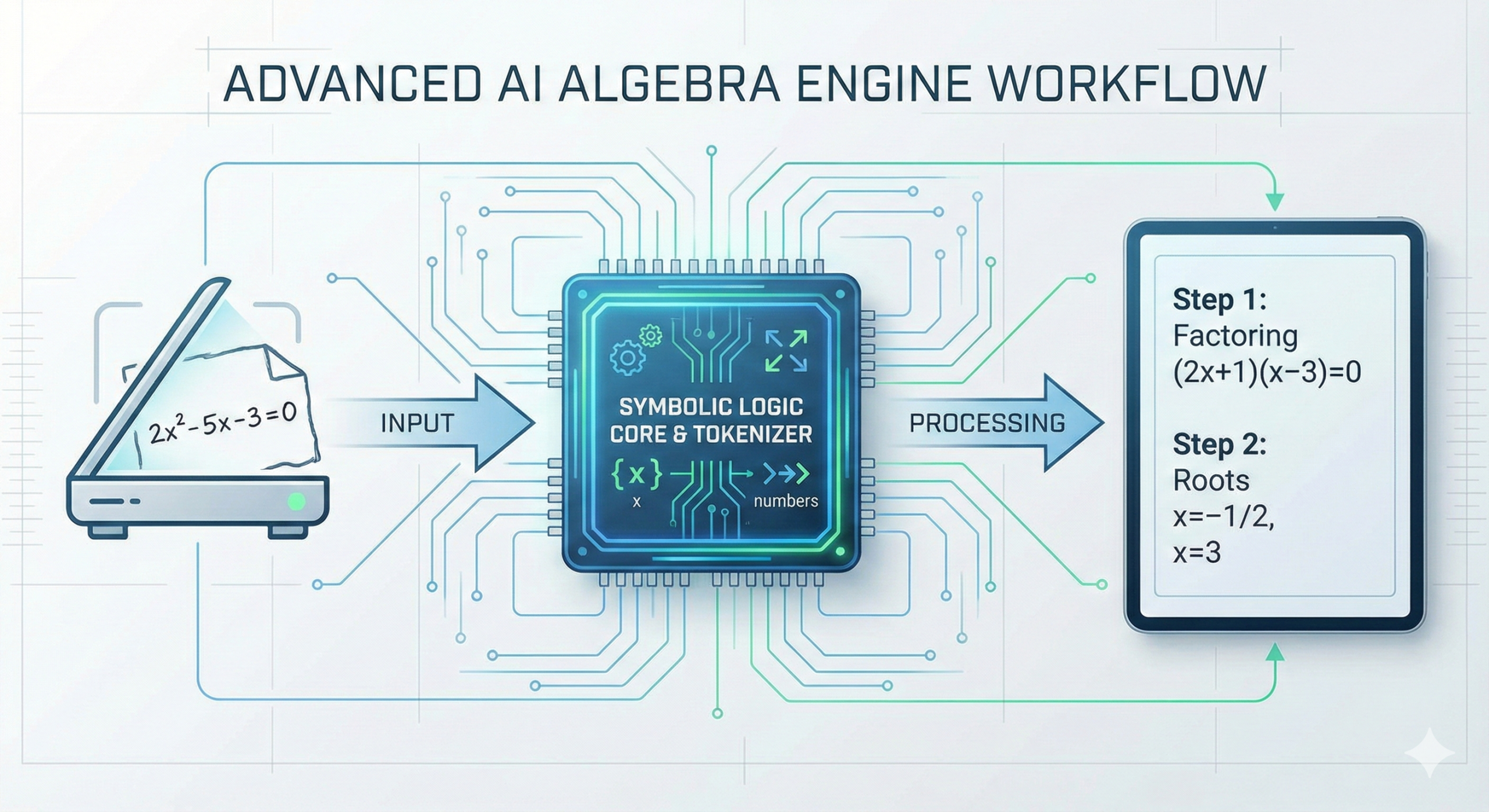
Comprehensive Support for All Algebra Levels
Our solver is not limited to basic school homework. We have expanded the engine to cover university-level Abstract Algebra and Linear Algebra concepts. Whether you are dealing with the Distributive Property or complex Gaussian Elimination, the logic remains consistent.
| Mathematical Domain | Complex Expressions | AI Logic Applied |
|---|---|---|
| Linear Algebra | $2(3x - 4) = 5x + 10$ | Term isolation, simplification, and coefficient balancing. |
| Quadratic Logic | $x^2 - 7x + 12 = 0$ | Factoring, Discriminant analysis, and Root derivation. |
| Systems of Equations | $\{2x+y=5, 3x-y=10\}$ | Substitution, Elimination, and Matrix Row Reduction. |
| Logarithmic Equations | $\log_2(x) + \log_2(x-3) = 2$ | Property application (product/quotient rules) and base conversion. |
| Radical Expressions | $\sqrt{2x+5} = x-1$ | Squaring both sides and verifying for extraneous solutions. |
The Importance of "The Why" in Problem Solving
A numerical answer like $x = 4$ provides very little educational value without the underlying steps. Our Step-by-Step Algebra Solver is designed to act as a 24/7 digital tutor. By breaking down the **Rational Root Theorem** or **Synthetic Division**, the engine helps students identify the "logical bridge" between a complex polynomial and its factors.
For example, when factoring $x^3 - 4x^2 - 7x + 10$, the AI demonstrates how to test potential roots using the Remainder Theorem before performing the division. This visibility into the process is what builds true mathematical mastery.

Algebraic Problem Solving: Frequently Asked Questions
Can the AI solve for multiple variables?
Yes. The engine handles systems of equations with two, three, or more variables using Cramer's rule or substitution methods. It automatically identifies if the system is consistent, inconsistent, or dependent.
Does it support complex numbers?
Absolutely. If a quadratic equation has a negative discriminant ($\Delta < 0$), the solver provides roots in the form of $a + bi$, ensuring full coverage of the complex plane.
How does the AI handle word problems?
Our **NLP (Natural Language Processing)** layer translates text-based scenarios into symbolic equations before passing them to the logic core, making it ideal for word-based algebra challenges.
Does it support graphing and functional analysis?
Yes. Our logic engine automatically generates interactive graphs for any input function. The system identifies intercepts, vertices, and asymptotes, providing a full visual understanding of the algebraic structure.
Algebra in the Professional World
Beyond the classroom, algebraic logic is the backbone of modern civilization. Our solver is used by professionals to verify models in various high-stakes fields:
- Cryptography: Modern security relies on modular algebra and prime number theory.
- Data Science: Machine learning algorithms are essentially massive systems of linear equations and matrices.
- Aerospace Engineering: Calculating trajectories requires solving for multiple variables under dynamic constraints.